Monday, February 3, 2020

Oil Painter - Few Amazing Tips to Become Good Oil Painter: By Murtaza Habib

Oil paint contains a unique process and an artist has to understand it properly, if he wants to create a better painting. The purpose of this article is to make sure that you learn the basic process of oil painting and create beautiful painting. The basic law of oil painting is to find out the technique that suits your style and personality.

It's important that you learn the language and laws of oil painting as under, if you are new to this painting style.

1. This paint is wet.
2. This painting style is done using brushes.
3. It is different as compared to other painting media you have been using.

You have to think like an oil painter to create good oil paintings. Accept the fact that the oil painter looks at the world differently as compared to other people. Don't focus on the subject that is given to you for painting.


Keep the oil paint in your mind and treat the subject like the process only. Clear the process in your mind and apply the action using your brush. When you gain this thinking style, you can create any kind of painting no matter what the subject is. Don't take this point lightly, because I have told you the secret that I have never told anyone as yet. You should have your own unique style to see the world.

Capture the new ideas and make a note if possible. Always be confident about your success while creating the painting. Choose the right method that suits your style and keep going on. Don't confuse yourself by asking many questions regarding the selection of surface, brush and other stuff. You just need to keep remember all the procedure required to create the painting.

If possible then read the oil painting books and gain deep knowledge regarding this painting style.

Learn from todays expert how to paint and draw step by step with the help of pictures on your core subject whether it is oil, watercolor, acrylic, fabric painting, pencil, cartoon drawing, or digital art.

Explore your creativity with these 1750 tutorials - Painting and Drawing lessons [http://www.paintonmycanvas.com/ezine.html]

'Murtaza Habib' has helped hundreds of newbies to start their painting courses, now you can do it too...


Article Source: Here
Photo: Valeriia

Friday, January 31, 2020

Artist Uses Her Own Thigh as a Canvas for Stunning Ink Drawings

Lately, social media platforms like Instagram and Pinterest have been flooded with a renaissance of unique tattoo art. Many young people today enjoy the self-expression of adding art to their own skin, even when it’s in temporary form. Such is the case for artist Randa Haddadin, who has taken her romantic painting style to a reusable canvas—her body.


Based in Dubai, Haddadin’s art explores emotions, people, and dance. Recently, the artist has transferred her expressive technique to a series of body art illustrations. “It started a few years back as a spontaneous gesture without overthinking or much preparation—where all you need is a pen and, well, a leg or arm or back,” says Haddadin. “One canvas with so many temporary possibilities. A moment in time that’s not meant to last, but kept as a memory.” Fortunately, each drawing Haddadin makes on her legs or arms is documented on her Instagram before it disappears. Among her works are portraits, dancing figures, architecture, and botanical motifs.

“It’s a therapeutic process for me, where I don’t need to worry about the end result—keeping it, preserving it, or selling it. Instead, I can focus on the process of creating and enjoy the spontaneous strokes. The comfort of its temporariness gives me more room to be braver with my lines, unlike a permanent tattoo or a sealed oil painting,” explains Haddadin.


You can follow Haddadin on Instagram to keep up to date with her latest body art creations.

Original article: Here

Monday, January 27, 2020

Learning How to Use Your Paint Brush: By Amy Ressa

If you are a self taught artist, you may be missing out on basic techniques to use when you are doing your decorative painting. It is never too late to take the time to learn. Add this knowledge to your current skills and improve your finished products. Learning never stops and can help keep your work fresh and up to date with the times.


Strokework is the basis behind decorative painting. Once you have mastered the different strokes, you will be on the way to creating beautiful artwork. By learning these different techniques you will be able to do different types of decorative painting. Combining techniques will allow you to create more interest in your work. These strokes can be used on small projects like painting glassware, painting on furniture, or walls.

If you are a painter who did not learn how to use your brush and the different strokes from the beginning, you will notice the difference in your work if you take the time to learn. It allows you to understand how to hold your brush, the amount of pressure, and how the paint works in your brush. This is information that is beneficial no matter what type of painting you do.

There are two main elements to stroke work. One element is downward pressure and the other is sideways pressure. The amount of pressure will determine the width of your stroke. Of course, the more pressure you exert, the wider your stroke will be. As with the less pressure you use, the smaller your strokes will be.

My name is Amy Ressa. I am the owner of The Painted House and More. My business is located in Central Ohio. I am however always interested in working with others that are located throughout the United States and not limited to Central Ohio. I am a decorative painter who offers a service to paint items for weddings and special events. These items can include ring bearer pillows, flower girl baskets, cake and knife serving sets, plates, dessert or wedding cake plates, centerpieces, and more. I am open to any ideas you would like to discuss.


Article Source: Here
Catch Amy here
Photo: Dominika

Friday, January 24, 2020

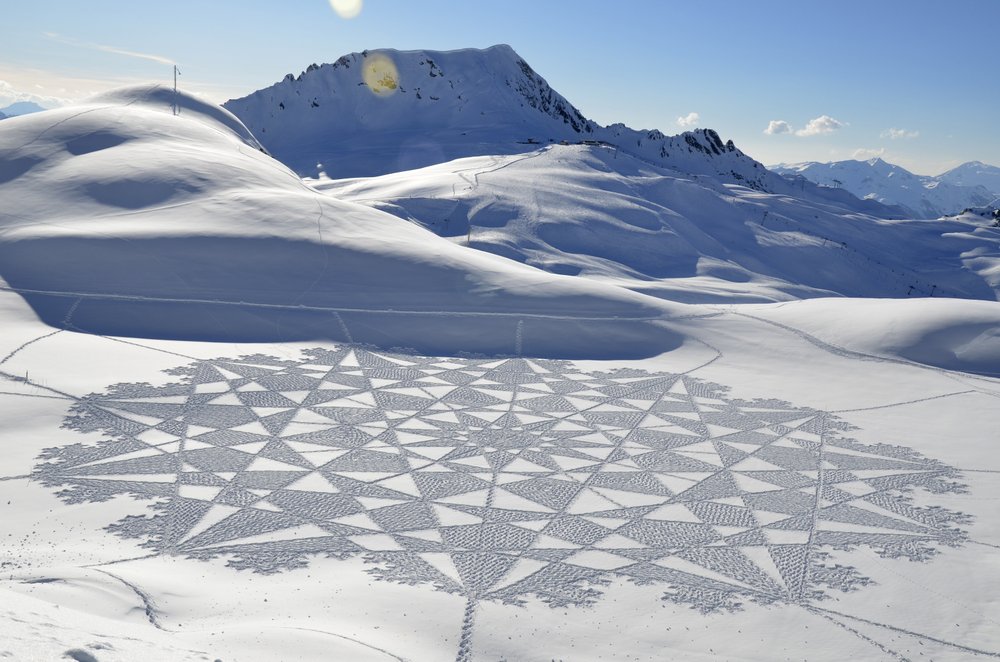
Artist uses snow as canvas for massive geometrical designs

SILVERTHORNE, Colo. (AP) — Simon Beck carefully plots his course before shuffling through a windswept snowfield high in the Rocky Mountains.

Using a compass, snowshoes and his background as a cartographer and competitive orienteer, the 61-year-old British artist and a handful of volunteers recently tromped across a frozen reservoir near the ski resort town of Silverthorne, west of Denver, to create a massive, geometrical design on a fresh canvas of snow.

The result after more than a dozen hours of labor in freezing weather and under an unrelenting sun was a spectacular spiral pattern the length of about two soccer fields.

“I hope it makes people more aware of the snow and the environment and the beauty of it and how we need snow,” Beck said after completing the drawing. “And I think it’s a really beautiful and unique art form.”

Beck finished his day with high fives from his volunteers and congratulations from people who gathered on a nearby hillside to watch his progress.


But it hasn’t always gone this smoothly. It’s never clear how many workers will show up. And if bad weather rolls in, an intricate piece of art can quickly disappear.

“It’s very frustrating when you plod around for hours and hours and hours and then the wind blows it away before you’ve finished it,” he said.

Beck started making fractal drawings in snow in 2004 outside his winter home at France’s Les Arcs ski resort when he trampled out a five-pointed star spanning more than 300 feet (91 meters) “just for a bit of fun.” He didn’t realize how good it looked until he rode a ski lift the next day and saw it from above.

“Snow drawing, which to me seems like a fairly obvious idea, was not something anyone else had ever done as far as I could tell, and I was really surprised by that,” he said.


Beck has completed about 330 snow drawings and 120 in sand, and has set a goal of 1,000 total drawings by the time he’s 80. His drawings are commissioned around the world, he has published a book, and he has attracted a dedicated fan base.

Carolyn Tiller, who has been following Beck’s career for three or four years, watched his progress on the reservoir and delivered him and his crew cookies and spiked cocoa.

The 62-year-old retired gemologist said Beck’s art reminds her of her childhood playing with a Spirograph, the classic toy that makes it easy to create detailed geometric drawings.

“I also really appreciate someone who can make something by one step after another step after another step,” said Tiller, who lives across the street from the reservoir. “They say the greatest journeys start with one step, and that’s a perfect example.”

https://apnews.com/6e88e14e58e3c0ba21e41761342f6210

Saturday, January 18, 2020

Painting Styles - Painting Has Undergone Variety Of Experiments

Paintings manifest the thoughts and visions of human beings through the language of art. A wide array of painting styles, methods and techniques has enhanced the horizon of painting making it more enriched and versatile. Painting has undergone variety of experiments under the hands of the master artists, which resulted into a vast selection of painting styles. The core philosophy behind the artwork, the painting styles introduce us to the various movements and schools of art. A single style also serves as a record of a particular historical period and culture prevalent during the time. Painters generally opt a particular painting style and carve their portraits typifying that specific style. Hence it is very necessary to read the various painting styles to understand the subtle strokes of each artwork.


The painting styles are visible with the emergence of 'Romanesque Art' in the eleventh century. The Romanesque paintings characterized by decorative leaf motifs are to be viewed in all Roman imperial structures. The 'Gothic Style of Paintings' evolved in the mid twelfth century in the form of frescos, panel paintings, manuscripts and stained glasses.

Oil and canvas paintings became popular in the later time with the origin of the 'Renaissance Style of Art' in the fourteenth century. Art became more realistic and secular through linear forms, anatomical shapes and use of light and shadow. The legendaries of paintings Raphael, Michelangelo and Leonardo da Vinci were artists of the Renaissance period. 'Baroque Style of Painting' evolved in the seventeenth century with the 'Baroque Cultural Movement'. Highly passionate, the paintings enlivened an ongoing action into art.

The 'Impressionism' of the nineteenth century world is articulated through 'Impressionistic Paintings'. Ordinary themes from the nature and surrounding world were painted through distinct brush strokes. 'Pointillism' invoked a new technique of painting where tiny dots of primary colors were blended to form an image creating an impression of miscellaneous colors. 'Expressionistic Paintings' of the early twentieth century are artistic expressions of subjective emotions that painters experience from the subjective world.

Among the modern styles of paintings, 'Cubism' is popular. A precursor to abstract painting 'Cubic Paintings' introduced geometric shapes and figures as images. Pablo Picasso, Georges Braque and Marc Chagall are the noted painters of Cubism. Another famous painting style during the1920s was the 'Surrealistic Paintings'. The painters used beautiful images and incongruous juxtapositions to represent unconscious thoughts and dreams. The 'Dada Painting Styles' of the time of the First World War represented art works that conveyed a nihilistic attitude towards conventionalism. The paintings were a revolt against the aesthetic and contemporary style of art.

Abstract Painting is perhaps the most difficult and complex of all painting styles. Painting is portrayed in an objective and non-representational way through colors and lines. The paints are dropped, lined and smeared over the canvas generating an idea non-captured in image form. Jackson Pollock, Pier Mondrian and Barnett Newman are some famous abstract painters. Abstract Expressionism is an art movement of the post World War II. It emphasized the non-representational style of abstract art in a more audacious and dramatic way. Postmodern Art reflects the modern consumerism and the contemporary culture in the paintings. It rejects the elaborately narrative depictions of the modern art and emphasizes more on the insincerity and discontinuity that is more feasible in the present day.

For comprehensive information on paintings and related topics, please visit Ethnic Paintings

Amit Singh is Content Coordinator for http://ethnicpaintings.com This website gives you comprehensive informations on painting history, development, trends, popular painting styles, great painters, famous paintings, painting galleries and museums, painting tips, painting classes. In other words, this website is a treat to painting freaks.

Article Source: https://EzineArticles.com/expert/Amitseo_Kumar_Singh/179772

Wednesday, January 15, 2020

Art Supplies - Buying and Cleaning Paint Brushes

Remember when you were in grade school and painting seemed so simple because your teacher just handed you art supplies and helped wash brushes afterwards? Approaching the medium as a more mature artist, you must learn about paintbrush materials and how to properly care for your brushes.


First, you must decide whether you will need soft or stiff hairs for your paintbrush. Either can be made of natural hairs or synthetic fibers. A thin paintbrush is ideal when you want to do detailed work or precise painting. It allows you to spread paint easily. Hard bristles on the other hand are better for manipulating thick paint. This allows you to create brush marks in the paint that can be seen on the canvas. Vincent van Gogh's work is famous for this technique, as evidenced by his painting The Starry Night.

Most purists will say that natural hair will always be superior to synthetic fiber because of its flexibility and strength. The hair for paintbrushes comes from animals including Sable, squirrel, hog, camel, ox, pony and goat. If the thought of using hair from one of these animals makes you squeamish or you have ideological problems with this, do not fear: modern synthetic brushes have come a long way and are even less expensive than their natural hair counterparts.

The next step is to learn a little bit about paintbrush anatomy. The handle is usually made of wood and is called the ferrule. This holds the hairs or bristles. The tip of the bristles is referred to as the toe.

When deciding which paintbrush to use it is important to know the size of the brush. This can be determined by looking at a number on the side of the handle. The smallest size is 00 followed by 0, 1, 2 and so on. If you are buying online it is important to see a picture of the brush you're purchasing. Two brushes sized the same can actually be very different because of the number of bristles and the width of the handle. This problem can be alleviated if you shop in an actual store or are already familiar with the brand of brush.

It takes a lot of time and money to get the right paintbrush, so it makes sense to take care of them, which includes proper cleaning after each use.

Before you get started, make sure you have mild soap (or turpentine if appropriate) and some tissue. You will also need lukewarm water and a place to dry your brushes.

Wipe off the excess paint using a soft cloth or tissue. Then, rinse your brushes in turpentine if you are using oils, but use lukewarm water if you're paint is water-based. Hot water can cause the hairs of your brush to fall out. Afterwards, gently wash your brushes with mild soap. Rinse and repeat as many times as necessary until no color comes out and your brush returns to its original color. Next rinse your paintbrush in clean water. Remember to shake off the excess water after this. If the brushes seem misshapen, use your fingers to gently bring the brush head back to its original shape.

Now you are ready to dry the paintbrushes. Wrap the bristles in tissue or toilet paper while they are wet. When the bristles dry they will contract in this way and will maintain their shape. Let the brushes dry at room temperature. Be sure not to rest them on their head because this is another potential hazard to maintaining appropriate shape.

Since some of these materials can be toxic protect your skin with a pair of gloves. These can be purchased at an art store or even at a drugstore or hardware store.

Anne Clarke writes numerous articles for Web sites on art supplies, fashion, and home decor. Her background also includes teaching, gardening, and parenting. For more of her useful articles on art supplies, please visit Art Supplies, home of helpful tips and information about art and art supplies.

Article Source: https://EzineArticles.com/expert/Anne_Clarke/33662

Monday, January 13, 2020

Learn How To Paint Watercolors Fast - Use Only 1 Color

Learning to paint fast is difficult. Some say it feels impossible...

But it doesn't have to be so hard...

Like all skills, whether in Arts, Crafts or any profession the trick is to remove complication. Watch any expert work and you will be amazed how quickly they make the impossible seem easy...

Think of a Blacksmith making horseshoes on his anvil...

He knows how to make the fire hot enough to make the metal soft without melting
He knows that every strike of his hammer will shape and mould the steel
He knows just how to trim the hoof to make the shoe fit
He never doubts his ability to give the horse he makes the shoes for exactly what is needed for comfort and wear
It is an honor to see a craftsman at work. It is a privilege to witness the accumulation of many years hands-on knowledge.

Learning to be an artist takes time. Learning to paint professionally can take many years...

The fastest way to learn to paint watercolors is to take it in small stages... starting simple and building painting skills with small steps.

The first step is to paint watercolor using 1 color... it can't get any simpler...


You learn how to thin watercolor paint with your brush
You learn how much water you need to get a certain tone of color
You learn how to use water to carry color pigment across your watercolor paper
You learn what can go wrong when you touch your wet paper with a brush full of color
You learn to expect surprises
You learn to want to encourage surprises by experimenting with new techniques
And, most importantly, you get the opportunity to learn to draw with your watercolor brush... You learn how to make your brush become your best friend.

When you use only 1 color to learn how to paint watercolors it is easy to concentrate...

You can quickly learn how to get color tone right
You soon learn that color will flood and spread across wet paper
You know that if an earlier wash is fully dry it will be spoiled if you let your next brush mark touch
You find yourself doing amazing things with watercolors fast because you don't have to worry about which colors you need to mix that favorite green, or the orange you saw in last night's sunset.

Learning how to paint watercolors using only 1 color helps you learn fast because you don't even need to worry about making mistakes...

It is quick and easy to do it again because you have kept it simple
You have perfected the basics of learning watercolor painting
Perfect the basics of watercolor painting and nothing can stop you from mastering the next stage... Learning How To Mix Colors.

Michael Dale is the author of 1- Color Is Best (the quick and easy way to learn to paint watercolor) and 3- Colors Are All You Need (mix any color you want fast using only 3 colors). Contact [http://www.Paint-And-Draw.com] to find out more.

Article Source: https://EzineArticles.com/expert/Michael_Dale/145082