Showing posts with label art history. Show all posts

Monday, February 17, 2020

5 Popular Painting Styles: By Mayra A

5 Essential Painting styles to know and learn in order to effectively communicate and understand terms in the art world.

Baroque:
The Baroque style of painting originated in Rome and generally has a religious theme or is centralized around court life. Baroque paintings can be characterized by the abundance of details within the paintings as well as a sense of grandeur. Like the painting style, the word Baroque has come to mean something elaborate, including many small details.

Popular Baroque Painters Include:
Anthony Van Dyck
Paul Rubens
Vermeer
Claude Lorrain
Baciaccia
Agostino Carracci

Photo Credit

Cubism:
Cubism became a popular style of painting in the early 20th century. The cubist style of painting is abstract, where one can visualize the theme of the painting, but the objects are broken up and re-assembled into un-life like representations. With cubism, the artist attempts to show the viewer the subject from a multitude of viewpoints.

Cubism is often associated with Pablo Picasso paintings, one of the innovators of this style of painting. Another famous cubist artist is Georges Braque.

Photo: Credit

Expressionism:
The expressionist movement originated in Germany around 1905. Unlike the popular Impressionism painting style, expressionism attempts to provide the viewer with the painters view and opinion of the world and the subjects. This creates an image that is the artists own interpretation of the situation, often distorting reality and providing more of an emotional effect to the viewers. The Expressionist movement is known for paintings that represent and express intense emotion or angst.

Popular Expressionistic Artists include:
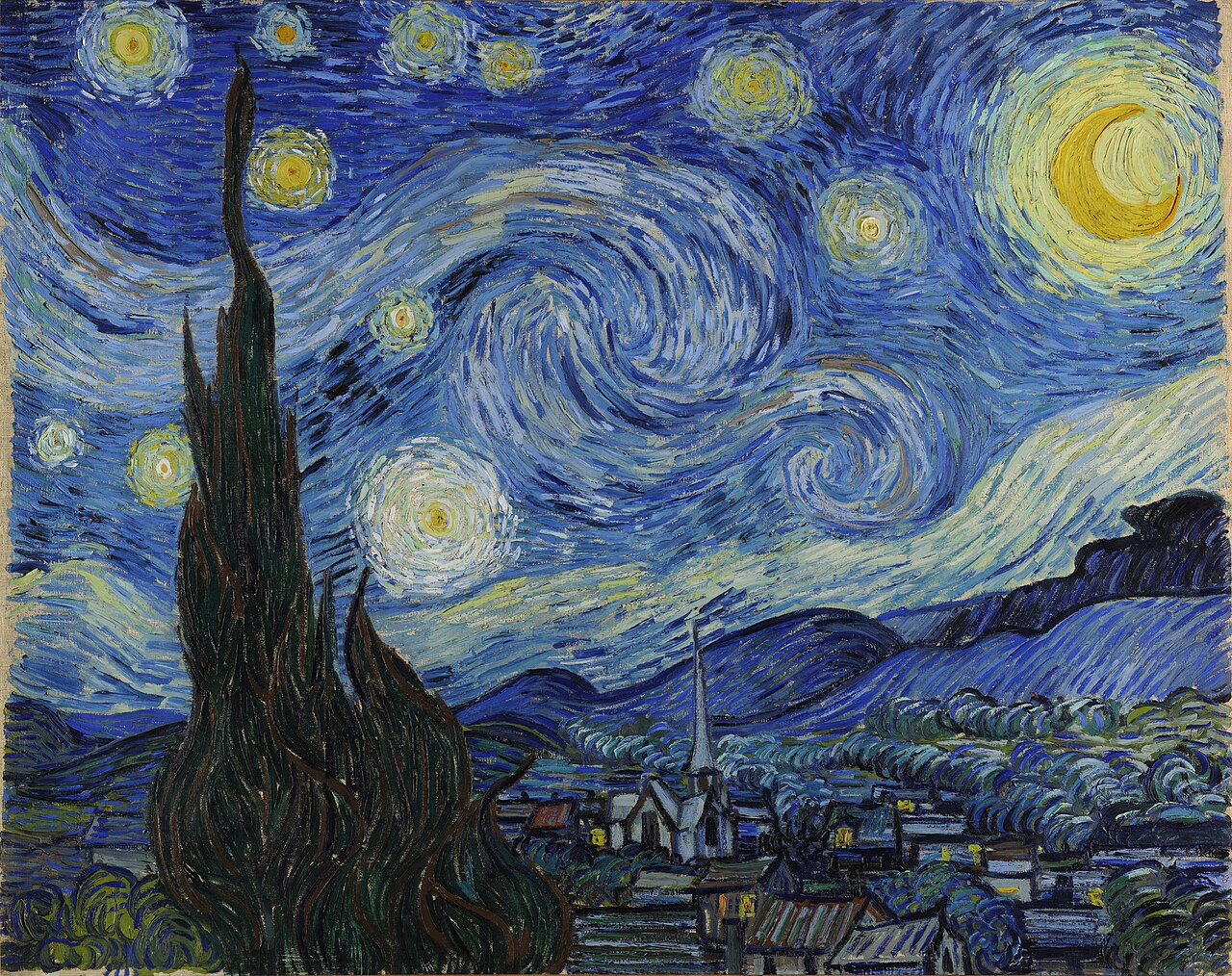
Vincent Van Gough
Edvard Munch
Salvador Dali
Henri Matisse

Photo: Credit

Impressionism: The impressionist art movement began around the 19th century in Paris. Impressionist style emphasizes the fine details of every day objects including how light, colors, and the passage of time can affect the subject. This style generally concentrates on visible brushstrokes, light colors, primary colors and small brushstrokes.

Popular Impressionistic Artists Include:
Edgar Degas
Claude Monet
Pierre Auguste Renoir

Photo: Credit

Minimalist: The minimalist style of painting originated in America and has been subject to much criticism since its inception. The style of painting includes minimal details, the details that are included are often represented by precise, hard brushstrokes and often include geometric forms. The color palette of these styles generally include a limited amount of unmixed, primary colors. The style of painting represents something that is spare and has been stripped to its most basic forms.

Popular Minimalist Artists Include:
Frank Stella
Ad Reinhardt
Robert Morris

Photo: Credit

The world of art and paintings is endless, and learning about its history, styles techniques and other useful information about painting is an ongoing task.

Want to learn more? Visit TheHelpIsHere.com [http://www.thehelpishere.com]

which offers thousands of useful help and how to articles on a variety of topics. All content is free to access, including our coupons and deals section, reviews, articles, and freebies area.

Article Source: https://EzineArticles.com/expert/Mayra_A/170644


Article Source: http://EzineArticles.com/2148593

Friday, February 14, 2020

Experts Conclude That This Odd Self-Portrait of Vincent van Gogh Giving the Side Eye Really Is by the Dutch Master

Leading experts on Vincent van Gogh have concluded that a strange portrait belonging to a Norwegian museum is actually an authentic work by the Dutch master. Extensive research conducted by the Van Gogh Museum in Amsterdam has shown that the artist executed the unusual self-portrait while he was suffering from psychosis.

The painting, from 1889, has been in the collection of Oslo’s Nasjonalmuseet since 1910, but its attribution to Van Gogh has been openly disputed since 1970. Over the years, some scholars took issue with crucial missing provenance details, while others deemed its style and dreary color palette out of key with the rest of the artist’s oeuvre.

While provenance research carried out at the Najonalmuseet in 2006 showed that the work had belonged to two friends of Van Gogh, Joseph and Marie Gioux, who lived in Arles, it was still unclear when the couple received the work. And, for a long time, experts couldn’t agree on a date of execution, or whether it was done in Arles, Saint-Rémy-de-Provence, or Auvers-sur-Oise.


In a bid to settle the matter once and for all, the museum invited the experts in Amsterdam to study the portrait in 2014. Now, after comprehensive inspection of its style, technique, material, and provenance, researchers have concluded that it is “unmistakeably” by Van Gogh’s hand.

The work turns out to be the only one that can be tied to a letter Van Gogh wrote to his brother Theo on September 20, 1889. What’s more, the letter proves that the work is actually a significant one, executed while the artist was having his first major psychotic episode at an asylum in Saint-Rémy. In his letter, Van Gogh describes it as “an attempt from when I was ill.” It is the only known work painted by the artist when he was in the throes of psychosis.

“Although Van Gogh was frightened to admit at that point that he was in a similar state to his fellow residents at the asylum, he probably painted this portrait to reconcile himself with what he saw in the mirror: a person he did not wish to be, yet was,” Louis van Tilborgh, a senior researcher at the Van Gogh Museum and an art historian at the University of Amsterdam, says in a statement. “This is part of what makes the painting so remarkable and even therapeutic.”

In mid-July of that year, Van Gogh entered a state of psychosis that lasted until September. At the end of the summer, in a letter dated August 22, he wrote that he was still “disturbed” but was well enough to experiment with painting again. This led experts to conclude that the work was done after August 22 but before September, and it therefore predates both of his famous 1889 self portraits in Washington’s National Gallery of Art and the Musée d’Orsay in Paris.

The work shows Van Gogh looking defeated, head slightly bowed and gazing sideways at the viewer with a lifeless expression. While the brownish-green pigments and somber palette seemed unusual for the artist who is known for his bright blues and yellows, the palette and brushwork are actually consistent with other works dating from the summer and autumn of 1889, which make sense within the context of the work’s execution.

The work is currently on view on the third floor of the Van Gogh Museum, and will be included in the museum’s upcoming exhibition of artists’s portraits, “In the Picture,” beginning February 21. After the exhibition closes in May, the work will return to Oslo where the Nasjonalmuseet is slated to reopen after renovations in 2021.

Original Article: Here

Monday, February 10, 2020

Pierre Bonnard - The Splendid French Painter: By Annette Labedzki

One of the most renowned French painters & printmakers, Pierre Bonnard was especially famous for his ingenious experimentation with color. He though, was not revolutionary in his style of painting, but he definitely was a master in portraying human emotions through colors. His fluency with colors fetched critical acclaim and appreciation from all art lovers.

Pierre Bonnard was born on October 03, 1867, in Fontenay-aux-Roses near Paris, to a highly placed French Ministry official. His childhood was therefore, spent in luxury and accordingly he had a very careless and idyllic youth. Due to parental pressure, Bonnard graduated in law and practiced briefly. He however, was always interested in art and took extra courses for the same during his free time. On March 11, 1887, he enrolled at the Scole des Beaux-Arts and resolved to be a full time artist.


In his youth, Pierre Bonnard co-founded a group of young 'Symbolic' and 'Spiritual' artists, called Les Nabis. He exhibited his works as a Nabi in the Gallery of Le Barc de Boutteville. During this phase, he heavily experimented with patterns in textile & furniture, while also exhibiting a Japanese effect in his work. His friends even lovingly called him 'a highly Nipponized Nabi.' In March and April 1891, Pierre first exhibited his work at the Société des Artistes Independants, gathering the much-needed support from all art critics. From then on, he exhibited yearly with the society.

In 1893, Pierre married Marthe de Méligny, who later modeled for a majority of his paintings. He obsessively portrayed her in her routine activities, stretching up to covering her nude. His works post marriage, therefore, turned quite personal in essence. Some of the famous paintings of those times include "Indolence" (1899) and "Man and Woman" (1900). In 1896, he had his first solo show at Galerie Durand-Ruel. Here, the great French artist Toulouse-Lautrec appreciated his award- winning poster. In 1910, Pierre left Paris for Southern France.

All the while, the painting range of the artist spanned from portraits to still life and landscapes. Bonnard would transform the mundane, simplest day-to-day objects into vibrating, iridescent, faintly represented subjects in his paintings. Small brush strokes imparted a marked influence of 'Surreal' mystery in them. The distinctive thing about Bonnard's paintings was the genuine time warp in them. The same objects in the room, such as tablecloths, teapots, and platters, rotated through the paintings. The subjects looked faint, creating a bizarre mystery. Some such renowned paintings are "The White Interior" (1932), "Still Life with Fruit" (1936), "The Dining Room in the Country" (1913), "Woman in Front of a Mirror" (1908), and "The Terrasse Family" (1902).

The artist died on January 23, 1947, leaving behind a great legacy of art. Pierre's passion for art is evident in his use of color with much vivacity and emotions. In 1998, his works were exhibited in the Metropolitan Museum of Art. The series of his paintings was titled, "Pierre Bonnard: The Late Interiors." He once quoted, "Before you add color, you must see things once, or see them a thousand times."

Annette Labedzki received her BFA at the Emily Carr College of Art and Design in Vancouver, B.C. Canada. She has more than 25 years experience. She is the founder and developer of an online art gallery featuring original art from all over the world. It is a great site for art collectors to buy original art. Is is also a venue for artists to display and sell their art . Artists can join for free and their image upload is unlimited. Please visit the website at http://www.Labedzki-Art.com

Annette has bonus offers on her work only. Buy 3 small paintings of any size (maximum size 11x17 inches) and receive 3 small paintings of your choice for free (maximum size 11x17 inches) SHIPPING IS FREE Buy one large painting (minimum size 18x24 inches) receive 5 small paintings of your choice (maximum size 11x17 inches) FOR FREE. SHIPPING IS FREE.

Please feel free to subscribe to her newsletter at http://www.Labedzki-Art.com

Article Source: https://EzineArticles.com/expert/Annette_Labedzki/252070

Photo: Here

Friday, December 27, 2019

Andrew Wyeth - Painter of the People

One of the most renowned artists of modern times, Andrew Wyeth continues to hold the American public enthrall with his almost photographic quality paintings. Using watercolors and egg tempera to create masterpieces from the familiar people and landscapes that he grew up around, Wyeth has an unmistakable style that infuses emotion into the mundane. Often using shades of gray and brown, his work combines subdued colors with his mastery of shadows to create incredibly detailed portraits and landscapes.


Born in a small town in Pennsylvania called Chadds Ford, Andrew was the youngest child of five. In the third grade he suffered a bad case of whooping cough which left him sickly for much of his childhood. His parents decided to educate him at home at that time and so his father, Newell Convers (N.C.) Wyeth became his main teacher.

The elder Wyeth was a well known illustrator whose work was featured in many magazines and in other mediums so Andrew was exposed to art from an early age. Seeing the budding talent in young Andrew, his father taught him the basic concepts of drawing and Andrew began working in watercolors. He was to do many watercolor studies of the sea and shoreline while at the family's summer home in Port Clyde, Maine. His first exhibit was of these paintings in 1937.

The success of that first show in New York City launched a career spanning seventy years. By 1950, he was named in Time magazine as one of the greatest American artists. One of his works, "The Hunter", was featured in the Saturday Evening Post. Wyeth paintings hang in museums across the country including the Museum of Fine Arts in Boston, MA., the Metropolitan Museum of Art and the Museum of Modern Art. In 1987, his "Helga" collection was displayed in the National Gallery of Art - the first time they ever exhibited the works of a living artist.

Despite his popularity and many awards, Wyeth's work was and remains a controversial topic among critics. His representational style contrasted sharply with the abstract art that was favored during the twentieth century. Art critics have often said that his work is too close to illustration and too sentimental in flavor. While some critics describe him as a genius, others are hostile and derisive of his work. His most famous painting, "Christina's World", is even deliberately left out of the listings of masterworks for The Museum of Modern Art where the painting hangs.

Mark Traston is an associate with Portrait Painting. The company specializes in turning a photo to painting. Each portrait artist specializes in a specific area including wedding paintings, pet portraits, and executive portraits.

Article Source: https://EzineArticles.com/expert/Mark_Traston/187410

Friday, November 8, 2019

History of Oil Paintings

Oil Paintings are the stuffs of a certain time and certain set, and art history of course tries to place these works in their superior setting. Any body learning western art, for instance, would study to be familiar with the styles of the Oil painting reproduction, Baroque, traditional, idealistic and Modern periods, and to know the complex interaction of consideration, support, civilization and monetary issues, which the oil paintings represent. It is to such a sympathetic that art critics refer when they insist that art today has to be comprised with contemporary issues.


The history of oil painting goes back to very old times when man endeavored to detain his world and knowledge in paint. It was profound in the grottos of Southern Europe when man assorted animal fats with earth and stain to form what could be measured as the first oil paints. The paint was then altered onto the walls of the grotto, with the prehistoric images of the hunters and the animals sought after becoming the earliest creative creations of humankind.

The oil painting medium developed when during the time of 15th century, Jan van Eyck the well known Belgian painter found that linseed oil and oil from nuts can be mixed with different colors to generate dazzling oil colors. Though there is proof that some English artists from the 13th Century made use of oils, van Eyck leftovers the discoverer and first advocate of oil painting technique, as we know it these days. In modern times, oil painting color is one of the most in style choices of appearance by artists globally, as it offers enormous variety & methods, strong depth of color vitality and durability that allow paintings to last thousands of years.

It is as well one of the most lenient mediums - the paint could be simply directed on the canvas and if you make a error you could always clean the color off the canvas (only with a cloth dipped in turpentine), due to the length of ventilation time. The amazing flexibility of oil color provides itself completely to the customary painting techniques of joining together and glazing, impasto and scumbling on a huge number of surfaces, giving the artist excellent results. These days oil painting reproduction is gaining more and more popularity.

Vijay is a Copywriter of Art reproductions He written many articles in various topics. For more information visit: Oil painting contact him at 1artclubpainting@gmail.com

Article Source: https://EzineArticles.com/expert/Vijay_Kanth/42438

Friday, November 1, 2019

History of Western Paintings - The Ancient Near East

Palaeolithic people led an unsettled life; this nomadic society of hunters and gatherers has little control over their food supply. Beginning around 8000 B.C. however, people began to grow their own food, raise their own animals, and organise into permanent communities. Although, like their Palaeolithic predecessors, the Neolithic people (from neos, meaning "new" in Greek) used stone to make basic weapons and tolls, organised agriculture and animal husbandry left more time and labour for other activities, including the production of clay vessels. Since their size and weight made them difficult to carry, clay vessels are characteristic of stationary communities.


Neolithic villages made their first appearance in the Near East, an area consisting roughly of modern-day Turkey, Iraq and Iran. A late example of Neolithic painted pottery from this region is a beaker from Susa (present day Shush in Iran) dating to c. 4000 B.C. The highly abstracted animal forms contained within patterned borders are common to many works of art from this area. Decoration takes precedence over naturalism to create designs with beautiful stylised animals, such as the thin band of elongated dogs beneath a frieze of graceful long necked birds around the top of the beaker, and the marvellous ibex with circular horns, it's body composed of two curved triangles, that dominates the large central portion. In contrast with Palaeolithic depictions of animals, which may represent attempts to control the animal kingdom, animals, now domesticated, seem simply to decorate this Neolithic vase.

The Paleolithic peoples who created cave paintings were monadic hunters and gathers. Neolithic culture (New Stone Age), which first appeared in the Near East c. 8000 B.C. is characterised by settled villages, domesticated plants and aminals, and the crafts of pottery and weaving. The highly abstracted, stylised animals forms, representative of the "Animal Style", and patterns decorating this Neolithic beaker from Iran are commonly found in workds from the ancient Near East. An ibex (wild coat), with enlarged, circular horns and a body consisting of two curved triangles, decorates the centre of this vessel. The top band contains skinny, long-necked birds, and, directly below, a band of elongated dogs encircle the beaker.

The early Neolithic agricultural communities gradually evolved into more complex societies, with systems of government, law, formal religion, and, perhaps most importantly, the first appearance of writing, thus marking the end of prehistory and the beginning of recorded history. The political structures alternated between conglomerations of independently ruled city-states and centralised governments under a single leader.

The city-states of the Near East frequently fought one another. In addition, the lack of natural barriers made the area particularly vulnerable to invasion. This almost constant warfare was a frequent subject of art. A further destabilising factor was the unpredictable climate; floods, drought, storms, and the like plagued the inhabitants of this region. This, they understandably tended to worry considerably about survival in this world - a world of invasions, political instability and natural catastrophes.

From about the fourth millennium B.C. the Sumerians inhabited southern Mesopotamia, a Greek place name meaning "the land between the rivers", that is the Tigris and the Euphrates rivers. They invented the wheel and a form of writing in which a stylus, usually a length of reed cut at an angle, was used to impress characters on wet clay. Cuneiform, meaning "wedge shaped", which aptly describes the appearance of this writing, has been deciphered; our ability to read ancient Mesopotamian texts makes the ancient art of the region more accessible to the contemporary viewer than the art of prehistoric societies. Ancient near Eastern images usually have clearly structured compositions, ground-lines and readable narratives emphasising human beings, their history, and their relation to their gods and goddesses. All of these characteristics enable us to interpret the art more easily than the more elusive prehistoric cave paintings discussed earlier.

Neolithic village communities in the ancient Near East gradually developed into complex city-states, which were often politically unstable societies almost contstantly at war with east other and against invading peoples. War and victory are frequent subjects of ancient Near Eastern art. This image, an inlaid panel from the side of a box, may show an actual historical event, depicting the aftermath of war, with a victorious banquet scene in the top register. Historical narrative and a clear, formal composition distinguish this image from prehistoric cave paintings.

The various city states that comprised ancient Sumer were often at war with one another. The so called Standard of Ur is a box, the function of which is not known, that was found in a royal cemetery among daggers, helmets, and other military regalia. The box displays scenes of both war and peace, probably episodes of specific historical events. Stylistically, the depictions of human form in the Standard of Ur resemble those we will see in other ancient cultures. Frontal and profile views are combined in a single figure, emphasising the conceptual over the illusionistic, and the size of a figure directly corresponds to his importance; on the Standard of Ur, the seated, regal figure in the top row is bigger than this standing before him. Also typical is the arrangement of figures in the bands. There is little overlapping of forms, or any indication of a setting, resulting in a very two dimensional image. This straightforward, regimented presentation of figures contrasts markedly with the informal arrangement of imagery in prehistoric caves.
Priest Guiding a Sacrificial Bull

Among the most famous achievements of the Mesopotamians are the construction and decoration of the Ishtar Gate, originally one of the main entryways to the ancient city of Babylon (Iraq). Babylon had been the political and cultural capital of Mesopotamia under Hammurabi, and towards the end of the seventh century B.C. with the decline of the Assyrians - probably the most powerful people to dominate Mesopotamia and the surrounding regions - The Babylonians reasserted their power. The best known ruler of this Neo-Babylonian period was Nebuchadnezzar II (ruled 604-562 B.C.), the famed leader mentioned in the Old Testament who was responsible for building the Tower of Babel and the Hanging Gardens of Babylon, as well as the Ishtar Gate, now reassembled in Berlin. The Ishtar Gate and the walls lining the Processional Way (the street leading from the Gate) were faced with glazed brick. Sacred animals, also of glazed brick - among them, lions, associated with the Goddess Ishtar, and dragons, sacred to Marduk, the patron God of Babylon - and these geometric borders ornamented both the Gate and Processional Way. The somewhat stylized forms of these animals, and their rhythmic arrangement within the decorative borders, recall the Neolithic vase from Susa, with which we began our discussion of the art of the ancient Near East.

Colin Andrews is the Director of Aspect Art Ltd, an on-line exporter of the highest quality reproduction oil paintings, http://www.aspectart.com

Article Source: https://EzineArticles.com/expert/Colin_Andrews/143251

Friday, October 25, 2019

Popular Painting Styles

In painting world there are so many styles that are very popular. But before giving an account of different popular styles we need to know what the term "style" means. In fact, there is not any certain definition of "style". It may be understood in the aesthetic terms as what to paint or which physical technique implied in painting. Aesthetic movements like realism, romanticism and impressionism belong to this explanation of style. To further understand it, we may say that style is said to be the ways an artist paints and applies colors and texture. The perspective and the way in which an artist looks at the things visible and invisible characterize his or her style.


Scholarly discourse on style has given more technical term "movement" or "school" to which an artist can be associated with. Inclusion of an artist to certain school or movement may be done by the deliberate affiliation of the artist to such movement or by the art historians.

Some of the popular painting styles are discussed under following heads:

Constructivism: This movement had started in Russia in the wake of socialism. It was not purely an art but was a fusion of art and architecture. This movement was principal inspiration in raising many socialist establishments in Russia after the October revolution. Constructivism was on high in the period between 1919 to 1934. The chief proponents of this style of art were Alexander Rodcheckno, Liubov Popava, Vladimir Tatlin and Olga rozanova.

Fauvism: This is painting style in which proponents believed in the use of color as a massive emotional force. This style was marked by expression of feelings in colors with severe roughness and clumsiness. The use of simplified lines to expressively reveal the subject and theme of the painting was also used to be the attempt of the artists. They preferred spontaneity and freshness over the finish in any work of art. Pioneer of this art style was Gustave Moreau.

Classicism: This term refers to the paintings style employed by the ancient Roman and Greek painters. Classicism is characterized by the simplicity and adherence to the basic rules and principles. This art style is refined and elegant, disciplined by order and symmetry. Classicism is unique style which does not encourage self expression and individuality. Michelangelo, Leonardo da Vinci, Raphael and Mantegna were the painters who tried to imitate this ancient style of art.

Besides, there are so many other styles and schools which are significant and have expressed different thoughts and subjects of the self and society in a unique way. Noteworthy of them are- abstract art, aboriginal art, aestheticism, art brut, art nouveau, baroque, Byzantine art, cubism, dada, dragging, encaustic, paintings, expressionism, gothic, impressionism, mannerism, marbling, minimalism, modernism, neoclassicism, orientalism, primitivism, ragging & stippling, realism, spattering, surrealism, symbolism, theorem paintings and wood graining.

Rajneesh Dubey is Content Coordinator for http://ethnicpaintings.com

This website gives you comprehensive informations on painting history, development, trends, popular painting styles, great painters, famous paintings, painting galleries and museums, painting tips, painting classes. In other words, this website is a treat to painting freaks.

To have more comprehensive idea about Popular Painting Styles please visit Ethnic Paintings

Article Source: https://EzineArticles.com/expert/Rajneesh_Dubey/126170

Friday, October 18, 2019

Female 20th Century German Expressionist Painter - Kathe Kollwitz

Born in 1867 to a father who was a radical social democrat who became a mason and house builder and educated by her grandfather on matters of religion and socialism Kathe Kollwitz dedicated her life to political activism. From an early age she was confronted by death when her younger brother died, leaving her deeply affected.


Her father's encouragement beginning at the age of 12 saw her progress artistically until she was old enough to go the Women's School of Art in Berlin, at a time when women were not allowed to study like men. At the age of 17 she got engaged to a medical student Karl Kollwitz whom she would not marry until 1891 when he was a qualified doctor. In the years in between she studied at Munich woman's art school, discovering there that she was a more talented draftsman than painter, then she returned to her home and rented a studio where she continued to draw Germany's working class laborers.

Two of her greatest works were The Weavers: an etching cycle inspired by the oppression of Silesian Weavers in Langembielau and their ultimately unsuccessful buy violent revolt in 1842, and The Peasant War: and etching cycle equally inspired by a violent revolution this time in southern Germany during the early years of the reformation when, in 1525, the peasants took arms against the feudal lords of the church who treated them as slaves.

During WWI she lost her one of her sons to the fighting and lost a grandson to WWII. All throughout her life she was a pacifist and produced anti-war art. She provided prints for the left-wing publications of pre-Nazi Germany and during the power struggle which followed the abdication of Kaiser Wilhelm II sought to ally the workers with the communist Soviets.

When the strongly anti-communist Nazis came to power they banned her from exhibiting and stripped her of her teaching post at the Berlin Academy of Art. Despite all this she stayed in Germany. She left Berlin in 1943, and during the latter days of the war her house was destroyed by an allied bomb, taking with it the majority of her work, all except a small portfolio she took with her.

In 1932 she finally finished her monument to the son she had lost in 1914: sculptures called The Grieving Parents. She was the first woman to be elected to the Prussian Academy of Arts. She died in 1945 in Moritzburg.

Works: The Weavers

Peasant War

Death and Woman

Death Woman and Child

Discover more of these artists and what they painted here:

http://www.squidoo.com/moonshine-art

Article Source: https://EzineArticles.com/expert/Kirsty_Semple/109534

Friday, October 11, 2019

German Expressionist Painter - George Grosz

As did many of the German artists of the time George Grosz fought in the trenches of WWI, having volunteered for military service. In 1915 he was discharged on medical grounds however he was drafted in the January of 1917 due to the shortage of soldiers, where he did not fight but guarded and transported prisoners of war, but by the May he was given permanent discharge as he was unfit for duty after a suicide attempt forced them to diagnose shell shock. Having faced his own disillusionment about the nature of war he turned his attention the bourgeoisies of 1920s Germany and painted a series of mocking caricatures of them and those who were in support of war.


He provided illustrations for German left-wing publications through his involvement with the German Dada group, and became a member of the KPD, the German communist party in 1919. He was arrested during the Spartacist uprising which marked the end of the German revolution, but he escaped using fake identification papers. In 1921 he was accused of insulting the army and was fined 300 German marks and had his work Gott Mit uns, God With Us - a satire condemning German Society - destroyed.

After spending five months in Russia meeting with people like Trotsky and Lenin he left the KPD, unwilling to live under any sort of dictator and as such his politics were strongly ant-Nazi. He was invited by the Art Studies League of New York to teach there in 1933, just at the time when the Nazis came to power. He received word that they had been to his apartment and his studio looking for him and so he stayed in America, becoming a naturalized citizen in 1938. During this time his work become more romantic and to many this signaled a decline.

He continued to teach, forming a private art school in his own home during the 1950s and he worked as an artist in residence. He was elected to the American Academy of Arts and Letters in 1954. He returned to Berlin where he died after a fall down some stairs in 1959.

Works: Suicide 1916

Fit For Active Service 1918

Grey Day 1921

The Face of the Ruling Class 1921

The Eclipse of the Sun 1928

Discover more of these artists and what they painted here:

http://www.squidoo.com/moonshine-art

Article Source: https://EzineArticles.com/expert/Kirsty_Semple/109534